It is one of the most common questions families face when a death occurs: should the children come? There is no single right answer — it depends on the child’s age and temperament, the nature of their relationship with the person who has died, and how the family feels about it. But there is a good deal of evidence about what tends to help children through grief, and it points in a fairly consistent direction.
The case for including children
Child bereavement specialists and psychologists broadly agree that children who are included in funerals — when prepared properly — tend to cope better with grief in both the short and long term than those who are excluded to “protect” them.
A funeral gives a child the same thing it gives adults: a clear marker that something has happened, a chance to say goodbye, and a sense of being included in the family’s shared experience of loss. Children who are not included sometimes struggle with a sense of exclusion, or with a lack of closure — an absence of something they cannot quite name but feel.
The key word is prepared. A child who arrives at a funeral without any understanding of what to expect will likely find it distressing. A child who has been told in age-appropriate terms what will happen, what they might see and hear, and who will be with them, is in a very different position.
How to prepare a child for a funeral
Preparation does not have to be elaborate, but it should be honest:
- Use clear language — children understand “died” and “death” better than euphemisms like “gone to sleep” or “passed on,” which can cause confusion or anxiety
- Explain what will happen — where you will go, what the building will look like, what people might do (crying is normal and okay)
- If it is a cremation, say so simply — “After the service, [name]’s body will be cremated, which means turned into ashes. It doesn’t hurt.”
- Tell them they can feel whatever they feel — sad, confused, or even okay. All of it is normal.
- Give them a role if it helps — carrying flowers, handing out the order of service, or choosing a piece of music can give a child a sense of participation
- Have a plan for if they need to leave — designate someone who can take them out quietly if needed, and let the child know this is an option
At what age?
There is no firm age threshold. Very young children — toddlers and under — are unlikely to understand what is happening and may find the environment and the emotions of adults around them unsettling. From around the age of four or five, children can begin to understand the concept of death and can benefit from being included with appropriate preparation. By school age, most children are capable of attending a funeral if they have been properly prepared and supported.
A child’s own wishes should be taken seriously. An older child who does not want to attend should generally not be forced; one who strongly wants to attend should usually be allowed.
If a child does not attend
If you decide a particular child should not come — or if the child themselves does not want to — it is still important to give them another way to mark the loss. This might be:
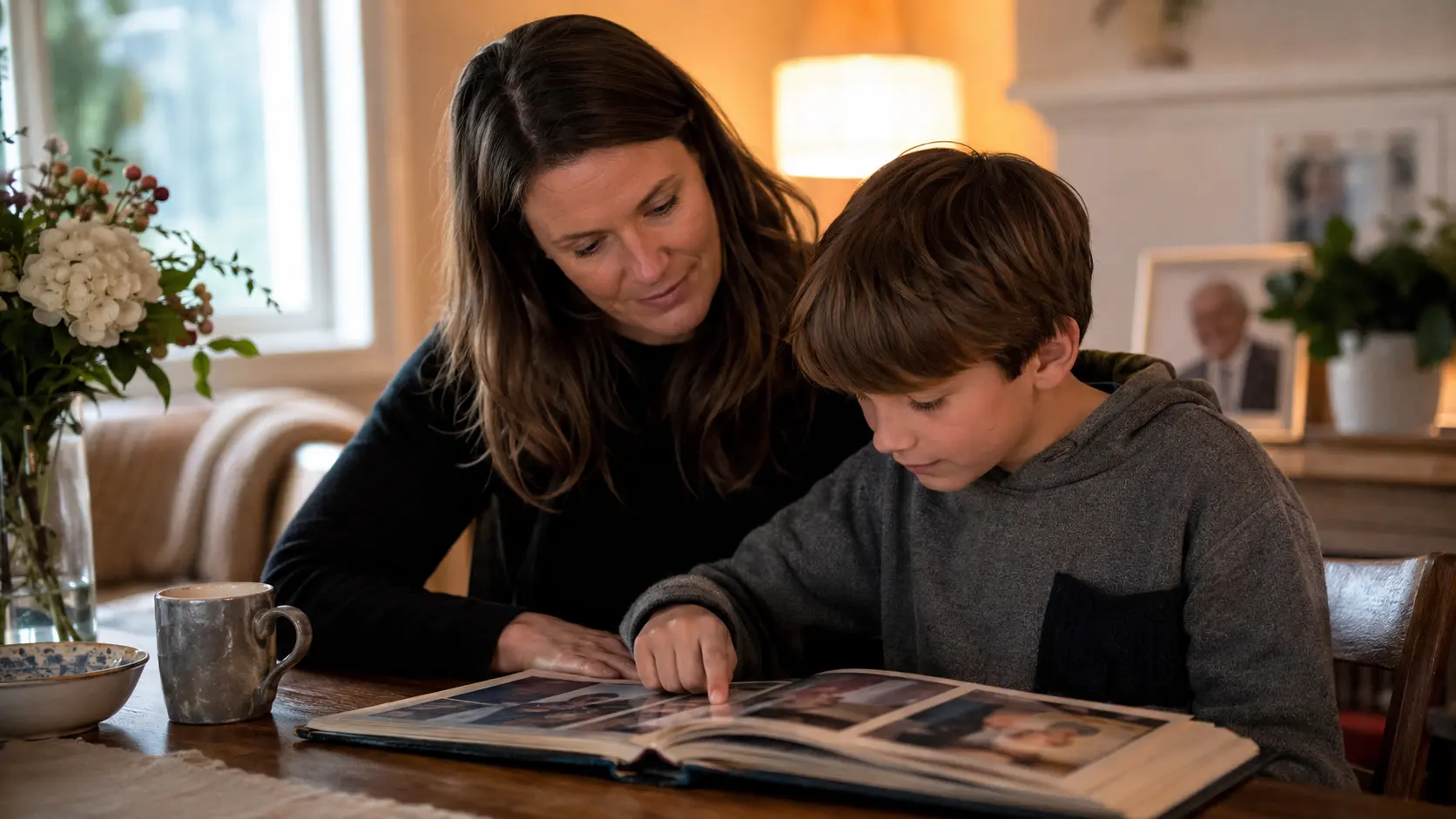
- A small private ceremony at home — lighting a candle, saying something, looking at photographs
- Visiting the grave or scattering location afterwards
- Helping to choose flowers or a piece of music for the service, even from a distance
- Making something — drawing a picture, writing a letter — that is placed with the person or kept by the family
The ritual of acknowledgment matters, whatever form it takes.
After the funeral
Children’s grief tends to come in waves rather than in one sustained period — they may seem fine for weeks, then something unrelated triggers a strong reaction. Keep communication open, follow the child’s lead, and do not assume that because they seem to have moved on, the work of grief is finished.
Winston’s Wish (winstonswish.org) and Child Bereavement UK (childbereavementuk.org) both offer excellent guidance and support for families navigating the loss of someone close with children in the family.
Our broader guide to grief and bereavement has more on sources of support, and our guide to supporting a grieving person may also be useful for those around the family.
Our guide to personalising a funeral may also be helpful — thinking about how to make the service feel familiar and accessible for children is part of the broader question of how to make it personal for everyone.