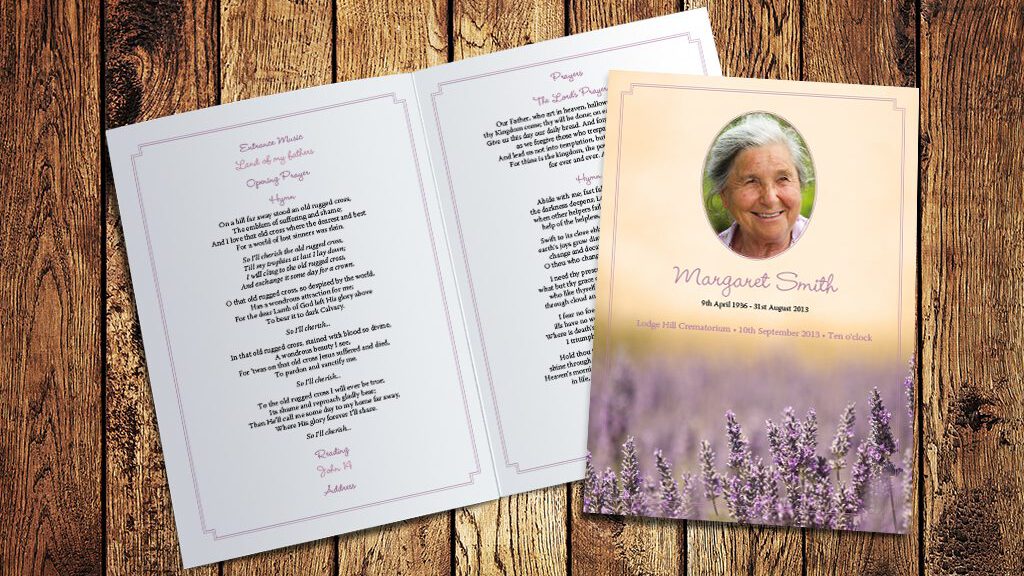
The basics of what goes in a funeral order of service — a photograph, a running order, the words to any hymns — are well established. The harder question is how to make it feel like this specific person. This article is not about the structure; it is about the choices within that structure, and the ideas that make one order of service distinctly different from another.
If you want a guide to what an order of service is and what it typically contains, we have written a separate guide to that.
Ideas for the front cover
The front cover photograph is often the most discussed decision. A formal portrait is not always the right choice — for many people, the photograph that captures them best is a candid one: laughing at a table, standing somewhere they loved, doing something they did every day. A fisherman on a riverbank. A gardener in her garden. Someone mid-sentence in a conversation. These images say something that a posed photograph cannot.
Some families choose a place rather than a person — a stretch of coastline, a view from a favourite hill, the garden they spent forty years tending. The person is present in the choice even when they are not in the frame.
The design around the photograph can do more than frame it. A colour drawn from the image itself — a blue from the sea behind them, a green from the trees — can carry through the whole piece and give it a visual coherence that feels intentional. A line of text on the cover need not be just a name and dates: a short phrase that was characteristic of them, a word they always used, something said at the right moment, can say more than any formal description.
Ideas for the personal pages
A brief biography is the most common addition to the personal pages — a life told in a few paragraphs, written by someone who knew the person well. But there are other ways to tell a life:
- A timeline — the key dates and places of a life, laid out simply. Particularly effective for someone who moved around a lot, or whose life had several distinct chapters.
- A photograph sequence — images from different decades, placed in rough chronological order. Watching someone age across a page is quietly moving in a way that a single photograph is not.
- A list of things they loved — not a formal tribute but something more like a portrait: the places, the foods, the television programmes, the routines that made them who they were.
- Their own words — a letter they wrote, a card, a passage from something they kept. If the person was a writer, or simply someone who expressed themselves well in writing, their own voice on the page can be more powerful than anything said about them.
- A QR code — linking to an online memorial, a Spotify playlist of their music, a video tribute. Something that gives people a way to continue the remembrance after the service ends.
Ideas for the back cover
The back cover is the last thing people read as they leave. It deserves as much thought as the front. A closing poem or verse is the most common choice — something that serves as a final word from the family. If you are looking for ideas, our guide to poems for memorial cards has suggestions that work equally well here.
Practical information — details of the wake, a charity donation request — belongs on the back cover too, but does not have to feel functional. A note from the family thanking people for coming, written in the family’s own voice rather than a formal acknowledgement, makes the back cover feel human.
Matching the memorial card
If you are having memorial cards designed alongside the order of service, the back cover of the order of service and the memorial card can share a design thread — the same closing image, the same colour, the same poem. When the two pieces feel as though they belong together, the stationery has a coherence that people notice and remember.
Seeing what is possible
The best source of inspiration is often seeing what other families have done. Our design gallery has examples of orders of service across a range of styles — traditional and contemporary, simple and elaborate, religious and secular.
You might also find our articles on choosing funeral readings and writing a eulogy useful as you plan the service.
When you are ready to talk through what you have in mind, call us free on 0800 612 6484 or send us a message.