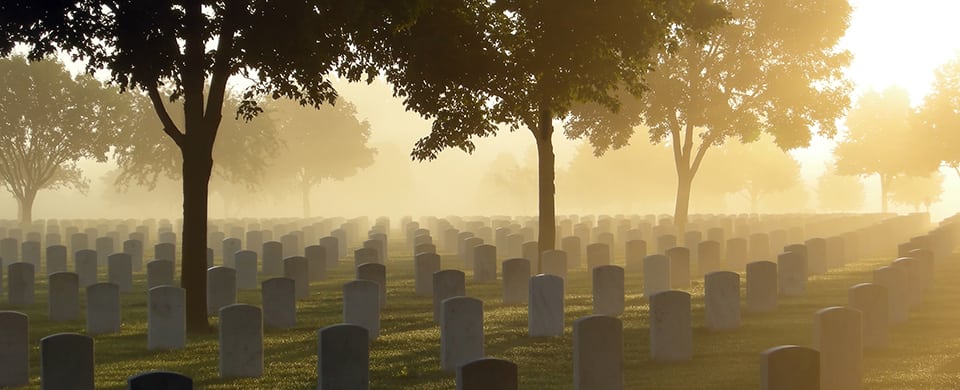
In this series, Funerals Explained, we look at what to expect from different types of funeral service. Here we focus on traditional burial — one of the oldest forms of farewell, and still the choice of around one in four families in the UK.
A brief history
Burial — or interment — is the placing of a coffin in the ground, typically in a churchyard, cemetery or burial ground. For centuries it was the standard form of farewell in Britain; cremation only became legally permitted in 1884. Today around 25% of funerals in England and Wales are burials, with the remainder being cremations. Burial remains the preference for many families — particularly where there is an existing family plot, where religious tradition guides the decision, or where the family wants a permanent, marked resting place to return to.
The type of service
A common misconception is that burial requires a religious service. It does not. A burial can be accompanied by any style of ceremony — religious, humanist, civil or entirely informal. The burial itself is the act of interment; what happens beforehand is entirely the family’s choice.
In practice, burial funerals most often begin with a service at a church or chapel before the coffin is carried to the graveside. The service includes music, readings, a eulogy or tribute, and any religious or non-religious content the family has chosen. Sometimes the graveside is within the churchyard itself; sometimes it involves a short journey to a nearby cemetery.
At the graveside
At the graveside, a few words are said — traditional liturgical words, something more personal, or both — as the coffin is lowered. The words “earth to earth, ashes to ashes, dust to dust” are among the most ancient and recognisable in the English funeral tradition. Family members may scatter a handful of earth as a final act of farewell. The symbolism is quiet and human: returning the person to the earth, letting go.
After the graveside committal, mourners leave while the grave is filled in by the cemetery staff. Some families prefer a private interment, asking most mourners to go ahead to the wake while only immediate family attend the graveside.
Family plots and plot availability
If you have a family plot, or a specific location in mind — a particular churchyard, a cemetery the person knew — let your funeral director know as early as possible. Plots in popular churchyards can be limited, and availability varies considerably by area. A double-depth plot allows two coffins to be placed in the same grave — one above the other — which is how family plots typically work. Your funeral director can check availability and make the arrangements on your behalf.
The headstone
A headstone is not installed at the time of burial. The ground needs to settle first — usually three to six months — before a permanent stone can be placed without the risk of it subsiding. Families typically choose and commission the headstone in the weeks after the funeral, with installation in the months that follow. The inscription is entirely the family’s choice; the stonemason or the cemetery office can advise on character limits and lettering styles.
Cost
Traditional burial is generally more expensive than cremation. The cost of a burial plot, the digging fee, the headstone and its installation all add to the funeral director’s fees in a way that a cremation does not. Families should request a full itemised estimate before committing. If cost is a significant consideration, a funeral director can advise on the options — including the choice between a churchyard burial and a municipal cemetery, which often differs considerably in price.
Grave goods
Personal items — letters, small mementos, photographs — may be placed in or with the coffin, provided they are discussed with the funeral director in advance. Some materials cannot be included; your funeral director will advise on what is and is not suitable.
The order of service
For a burial with a church or chapel service, an order of service covers the same content as any funeral — the running order, hymn words, biography, photographs. Some families also have a brief printed card for the graveside: a poem, a short reading, the words that will be said as the coffin is lowered. Separate from the main order of service, this gives those present something to hold at the graveside and take away as a keepsake of that specific moment.
You may also find our articles on cremation, green and woodland burial and burial at sea useful when considering the options.
Call us free on 0800 612 6484 or send us a message to talk about an order of service for a traditional burial.