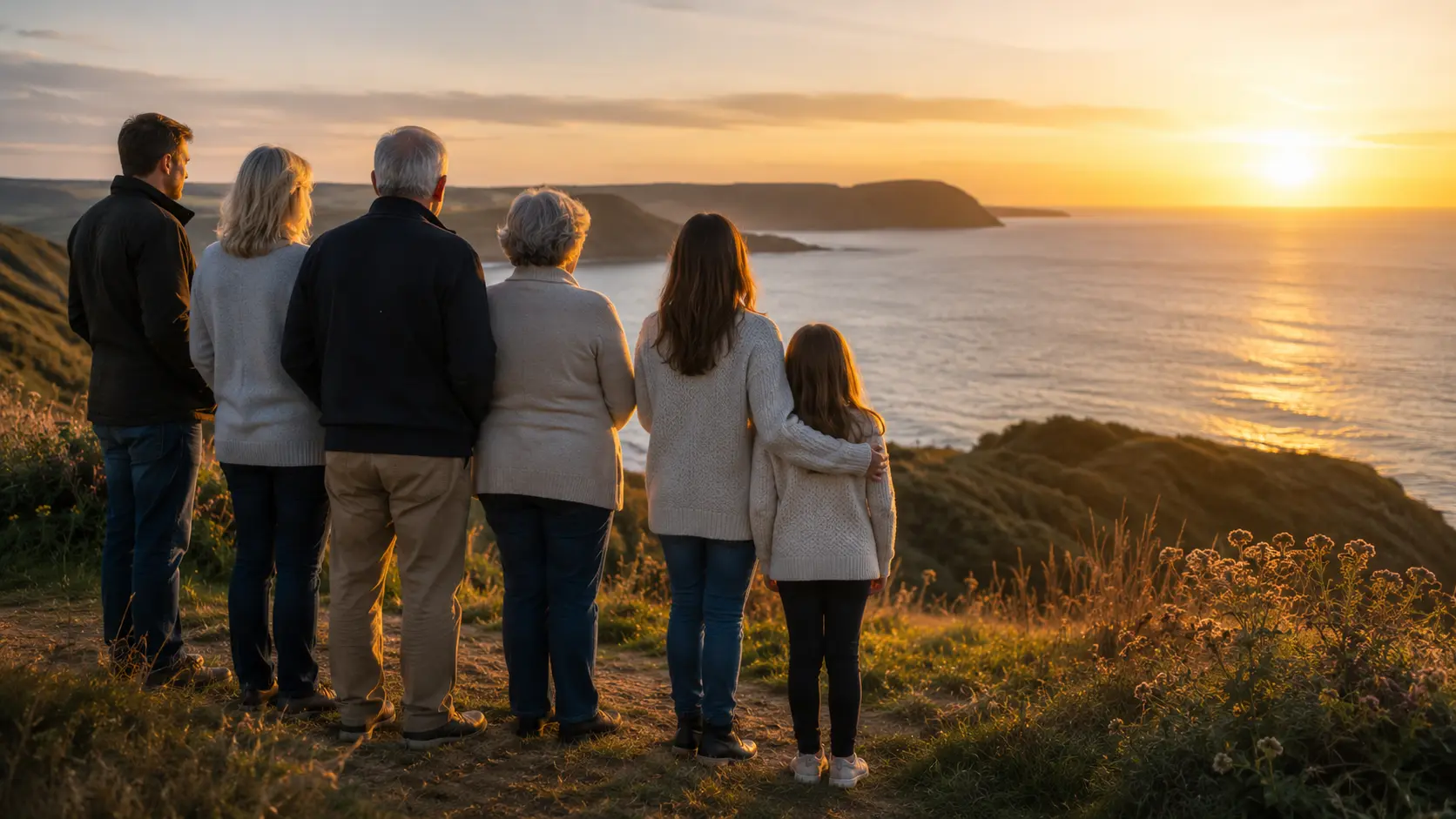
Scattering ashes is often the last act of farewell — a ceremony in its own right, separate from the funeral, and for many families the most personal part of the whole process. It can happen days, weeks, or even years after the death, and it can take almost any form the family chooses.
This guide covers the practical and legal side of scattering ashes in the UK, and some thoughts on how to make the moment as meaningful as it deserves to be.
Is it legal to scatter ashes in the UK?
In most cases, yes — but there are rules that vary by location:
- Private land — you need the landowner’s permission. Most will give it, particularly for a meaningful location, but it is courteous and legally sensible to ask.
- Public parks and gardens — the relevant local authority or parks management body should be contacted. Many have a quiet process for granting permission.
- Rivers, lakes and inland water — the Environment Agency (in England) should be informed. Ashes must not be scattered in a way that causes pollution.
- At sea — permitted and common. The Maritime and Coastguard Agency (MCA) has guidance; generally, scattering more than three nautical miles from shore is advised, and you should notify the MCA in advance.
- Churchyards and cemeteries — each has its own policy; contact the relevant church or burial authority.
- Football grounds and sports venues — many have a formal process for this, given how often it is requested. Contact the venue directly well in advance.
There is no legal requirement to scatter ashes at all — you can keep them at home indefinitely, divide them between family members, or choose a memorial product that incorporates them.
When to scatter
There is no right time. Some families scatter ashes on the day of the funeral; others wait months or years until the timing feels right. A meaningful date — a birthday, an anniversary, a time of year the person particularly loved — can make the moment feel deliberate rather than arbitrary.
Waiting also gives family members who were unable to attend the funeral a chance to be present, which can matter a great deal.
Making it a ceremony
Scattering ashes does not require a funeral director, a celebrant, or any formal structure — but a little intention goes a long way. Some things families find helpful:
- Gather the people who matter, even if it is only two or three
- Read something — a poem, a passage, a few words of your own
- Play music, either live or from a phone
- Give each person present a chance to say something, or simply a moment of silence
- Bring flowers to scatter alongside the ashes
- Mark the place in some way, if the location permits — a planted bulb, a stone, a small plaque
The ceremony can be as simple or as elaborate as feels right. What matters is that it is intentional — that the people there have come together for a specific reason, and leave feeling that something was properly acknowledged.
Practical considerations
A few things worth knowing before the day:
- Check the wind direction — stand so the wind is behind you
- Ashes are heavier than most people expect and sink quickly in water
- If scattering at a favourite beach or coastal location, check tide times
- If you are travelling abroad to scatter ashes, there are customs regulations — the funeral director can advise on the paperwork required
Alternatives to scattering
Not every family wants to scatter. Other options include:
- Interring in a churchyard or cemetery — a permanent, visitable location
- Burying in a garden — legal on private land you own, but worth considering when you move
- Memorial trees and woodland burials — ashes are buried at the base of a tree, often in a designated woodland
- Memorial objects — a small portion of ashes can be incorporated into jewellery, glass, or other keepsakes
The order of service for a scattering ceremony
If you are gathering family and friends for a meaningful scattering ceremony, a simple printed order of service helps people feel prepared and gives the event a proper shape — even outdoors, even with only a handful of people. It can be brief: a cover with the person’s name and dates, a poem or reading inside, a photograph.
At Fitting Farewell, we create orders of service for exactly this kind of gathering — not just for the formal funeral service, but for any moment where families want something more considered than a phone screen and an improvised goodbye.
You may also find our guide to cremation in the UK and our guide to burial at sea useful if you are still in the early stages of planning.