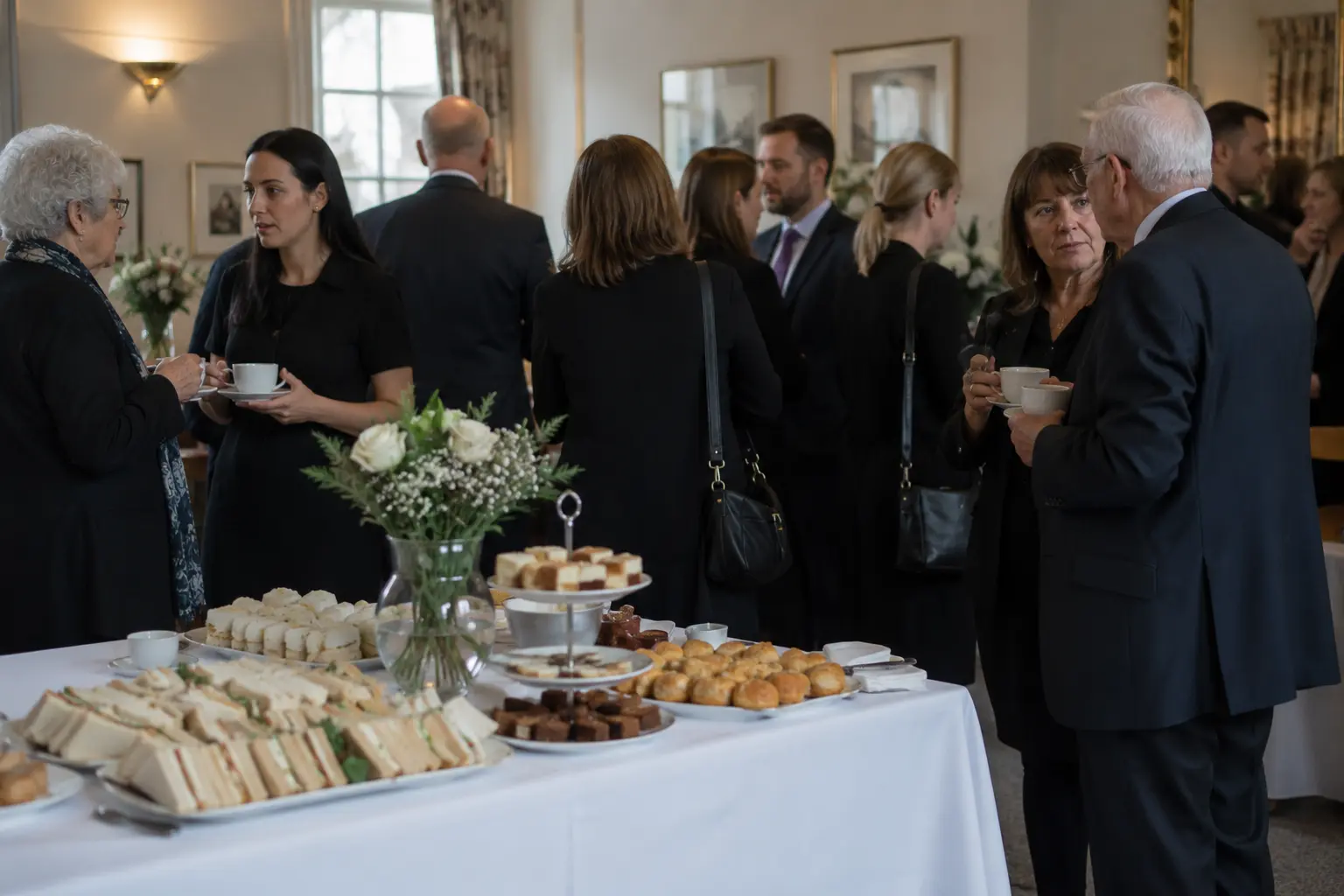
The wake — or funeral reception — is the gathering that follows the service. It is less formal than the funeral itself, and for many families it is where the real remembering happens: the stories that surface, the photographs passed around, the people who travelled a long way and need somewhere to sit and talk.
Planning it well makes a genuine difference, both to the day and to how those who attend feel when they leave.
Where to hold it
The most common venues are the family home, a local pub or hotel, a golf club, a church or community hall, or a private room at a restaurant. Each has practical advantages and drawbacks:
- The family home — intimate and personal, but puts significant pressure on the hosts and limits numbers
- A pub or hotel — staff handle food and drink, easier for larger numbers, less to organise on the day itself
- A church or community hall — flexible space, often suited to a buffet, usually lower cost
- A garden or outdoor space — can be beautiful in the right weather; always have an indoor fallback
The venue should reflect the person being remembered. A publican’s wake in a pub makes obvious sense. A keen gardener might be best honoured in a garden. It does not have to be the conventional choice.
Food and drink
A buffet is the most practical format for a wake — it allows people to eat when they are ready and keeps the atmosphere relaxed. Hot food is appreciated, particularly if guests have travelled. A full sit-down meal is less common but works well for smaller, closer gatherings.
If the person had a favourite meal, dish, or drink, including it is a quiet form of tribute that guests invariably notice and appreciate.
How long should it last?
Most wakes run for two to three hours. The gathering tends to find its own rhythm — an initial intensity as people arrive from the service, a looser period of conversation and remembering, and a gradual natural close. It is worth indicating a rough end time on any communications, partly to help guests plan and partly to give the family permission to draw it to a close when they are ready.
Creating a sense of the person
The wake is an opportunity to go beyond what was possible in the formal service. A few things that families find meaningful:
- Photographs — a display of images from different chapters of the person’s life gives guests something to gather around and talk about
- A memory book — a guest book where people write a memory or message, which the family can keep afterwards
- Music — a playlist of songs the person loved, playing in the background
- Favourite objects — books, a favourite mug, something from their hobby or work that tells a story
- A QR code — linking to an online memorial or a shared playlist, so guests can take it with them after the day
The order of service at the wake
Many families bring copies of the order of service to the wake, and guests often take them home as a keepsake. It is worth ordering a few more than you expect to need at the service itself — they tend to disappear. If you are planning a more personal display at the wake, the same photographs and text that feature in the order of service can form the basis of a larger printed board or framed piece.
Memorial cards — smaller keepsakes that guests can take with them — are also popular at wakes. Our guide to memorial cards covers the formats and what to include.
Practical things to arrange in advance
- Confirm numbers with the venue at least a week before
- Arrange parking or transport if the venue is hard to reach
- Designate someone other than the immediate family to manage arrivals and logistics on the day
- Let the funeral director know the venue details — they can include it on any printed notices
- Prepare a short word of welcome, or ask someone else to do so — guests appreciate being greeted formally even at an informal gathering
It does not have to be a wake
Some families prefer a celebration of life — a more deliberate, themed gathering that reflects who the person was rather than simply following convention. This might involve activities they loved, a visit to a meaningful place, or a gathering that takes place weeks or months after the funeral when people are ready to celebrate rather than simply grieve. Our guide to celebration of life funerals has more on this approach.
At Fitting Farewell, we create orders of service and memorial cards that work as keepsakes long after the day itself — something guests take home and keep. If you are planning the service and the reception together, we are happy to help with the stationery side of both.
See also our guides to funeral keepsakes and funeral thank you cards — both are often connected to the wake arrangements.