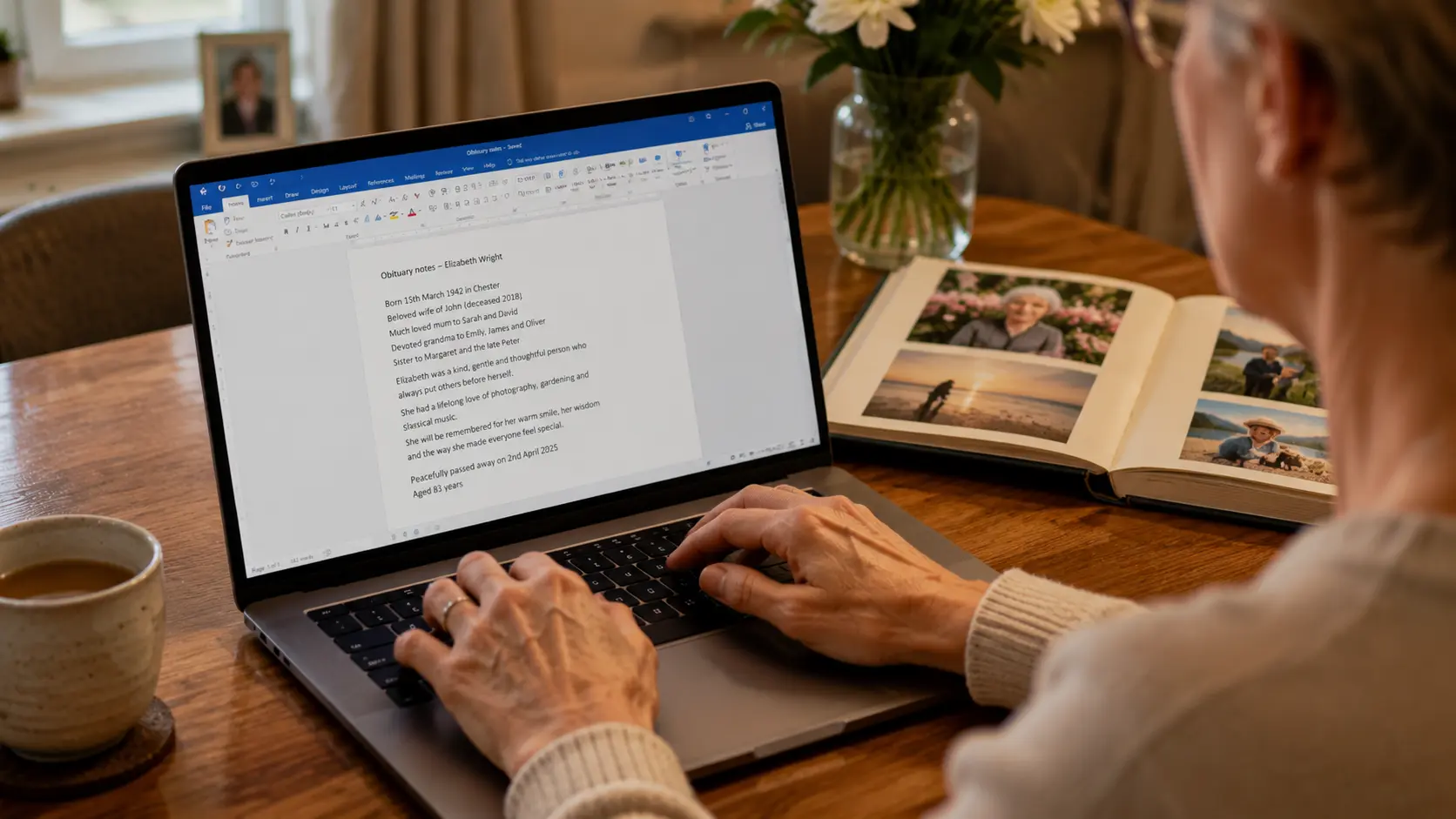
An obituary and a eulogy are not the same thing, though the two are often confused. A eulogy is the tribute spoken aloud at the funeral service. An obituary is a written notice of someone’s death — published in a newspaper, a funeral notice website, or shared online — that announces the death and gives others a sense of who the person was.
If you have been asked to write one, or simply want to prepare something before the funeral arrangements are finalised, this guide walks you through what to include, how long it should be, and how to approach the tone.
What an obituary is for
Obituaries serve two purposes: to inform people of the death who may not have heard directly, and to give a brief but meaningful account of the person’s life. In the UK, they appear in local and national newspapers, on funeral director websites, and on sites such as Legacy.com or the funeral notice pages of regional papers. Many families also share them on social media.
Unlike a eulogy, an obituary is usually written in the third person — “Margaret loved gardening and was known for her warmth” rather than “Mum always had time for everyone.” It reads as a record rather than a farewell.
What to include
There is no fixed format, but a complete obituary typically covers:
- Full name — including any names the person was known by
- Date and place of death — and age, if the family wishes to include it
- Brief life history — birthplace, education, career, significant life events
- Family — who they are survived by (partner, children, grandchildren, siblings)
- Character and interests — a sentence or two that captures the person as those who knew them will remember them
- Funeral details — date, time, location, and whether it is open to all or private
- Donations — if the family would prefer charitable donations in lieu of flowers
You do not have to include everything. Some families keep obituaries brief and factual. Others use them as an opportunity to write something more personal. Both are entirely appropriate.
How long should it be?
A newspaper obituary is typically 150 to 300 words — partly a convention and partly a practical matter of column space. Online obituaries and funeral notice listings can be longer, and many families find that once they start writing, the words come more easily than expected.
For a personal tribute shared on social media or included in the order of service, there is no strict limit. Aim for something that feels complete rather than exhaustive — a paragraph or two that leaves the reader with a clear sense of the person.
Tone and language
Write as the family speaks, not as you imagine an obituary should sound. Formal language can create distance where there should be warmth. If the person was funny, it is perfectly appropriate to let that come through. If they were quietly dignified and reserved, match that.
Avoid euphemisms unless they reflect how the family actually spoke. “Passed away peacefully” is common and gentle. “Lost their battle” implies a failure where there was none. Use whatever feels true.
Writing it: where to start
The hardest part is usually the opening. A practical approach is to start with the facts — name, dates, immediate family — and then write a short paragraph about who the person was outside of their biography. What would the people who loved them most want others to know? That is almost always the heart of a good obituary.
If you are struggling, try writing it as a letter first — to a friend who never met the person — and then shape it into the third-person format afterwards. The content is usually already there.
The relationship between the obituary and the order of service
The language you write for the obituary often finds its way into the order of service. A short biography, a description of the person’s character, the names of those they leave behind — these are exactly the elements that make an order of service feel personal rather than generic.
If you are working on both at the same time, it is worth drafting them together. The obituary forces you to distil the person’s life into a few clear sentences, and those sentences often become the foundation for the tribute on the order of service cover or inside pages.
At Fitting Farewell, we work with the text and photographs you provide and build the design around them. If you have drafted an obituary but are not sure how to shape the order of service, we are happy to talk it through. Many families find that conversation helpful even before they have made any final decisions.
You may also find our guide to what a funeral order of service is and our guide to writing a eulogy useful alongside this — the two pieces of writing draw on the same material but serve different purposes.