Music is one of the most powerful elements of a funeral service. The right piece — played as the coffin enters, or as the congregation sits in quiet reflection — can capture something true about the person that words alone cannot. This guide focuses on funeral hymns and classical funeral music. If you are looking for popular and contemporary song choices, we have a separate guide to those.
Hymns at a funeral
Traditional hymns remain the most commonly chosen music at UK funerals. They offer something that popular music cannot always provide: familiarity. When a congregation knows a hymn well enough to sing along, the collective voice in the room creates a moment of real emotional power — a shared act that draws people together at a time when they most need it.
A note on congregational singing
If you want the congregation to sing, it is worth sticking to hymns that are genuinely well known. A less familiar hymn — however meaningful it may have been to the person who has died — can leave most of the room silent while two or three people carry it alone. That is an uncomfortable experience for everyone, and it is easily avoided by choosing a hymn that the majority of those present will recognise.
The hymns below have all earned their place at UK funerals precisely because they are widely known across generations, denominations and backgrounds.
Abide With Me
Perhaps the most iconic of all funeral hymns. Written in 1847 by Henry Francis Lyte as he faced his own death, it has been sung at FA Cup Finals, at the Titanic memorial services, and at state funerals. Its opening line — “Abide with me, fast falls the eventide” — is recognised by almost everyone who hears it. For families wanting a hymn that carries weight and will be sung with confidence by the whole congregation, this is the natural first choice.
The Lord is My Shepherd (Psalm 23)
Set most often to the tune Crimond, this is one of the most comforting texts in the English language. Its imagery of still waters, green pastures and walking through the valley of the shadow of death speaks directly to the experience of grief and loss. Widely known across all Christian traditions and beyond.
How Great Thou Art
A hymn of extraordinary scale and feeling, particularly powerful when sung by a full congregation. It builds from quiet reflection to an uplifting chorus that fills a space — appropriate when the family wants the service to have a sense of celebration alongside sorrow.
All Things Bright and Beautiful
Often associated with childhood and with the natural world, this hymn is chosen most often when the family wants something that feels life-affirming rather than mournful — for a person who loved the outdoors, or for a service with a gentler, more hopeful tone.
Jerusalem
William Blake’s words set to Hubert Parry’s music is one of the most stirring pieces in English choral tradition. It is a strong choice where the family wants something with real emotional lift — particularly for someone with a strong sense of English identity or a connection to national institutions.
The Day Thou Gavest, Lord, Is Ended
A quieter, more contemplative hymn than some, but one that many people know. Its imagery of evening and rest makes it particularly appropriate for a service that is intended to be peaceful and reflective rather than celebratory.
Live singing and live music
If it can be arranged and afforded, live singing at a funeral is something quite unlike a recording. A single voice — a family member, a friend, a professional singer — performing a hymn or a song creates an intimacy and an immediacy that no recording can fully replicate. The imperfection of a live voice, the effort visible in it, the presence of a real person singing for the person who has died — these things move people in a particular way.
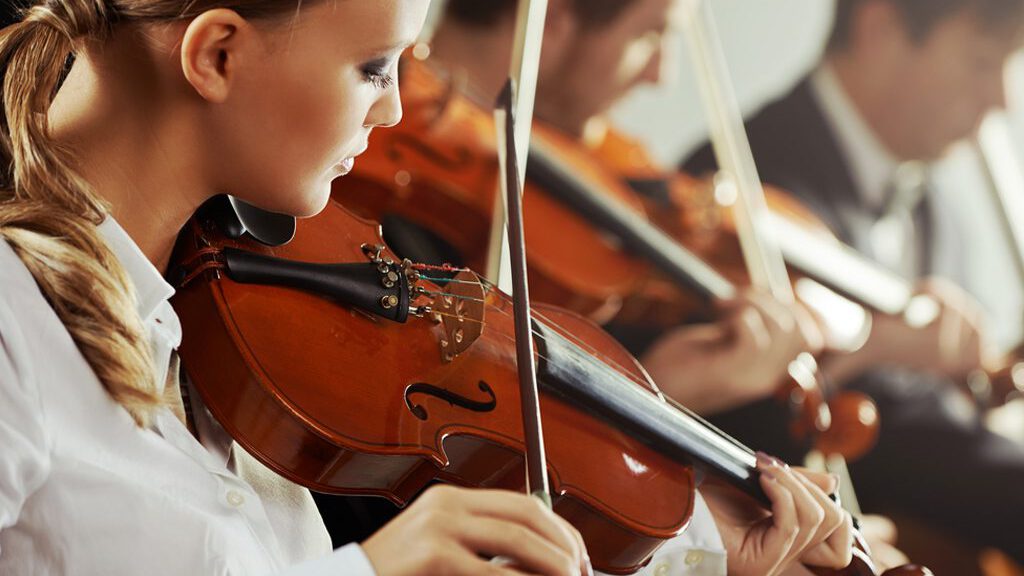
Live instrumental music — a pianist, a cellist, a string quartet — is equally special, though less common. Most crematoria and churches have a piano or organ, and some have resident musicians. It is worth asking early in the planning process what is available at your venue.
Live performances are not the norm at most UK funerals — practical and cost considerations mean the majority of services use recorded music — but when they do happen, families consistently tell us they were among the most memorable parts of the day.
Classical music at a funeral
Classical music is often chosen for the moments in a service that are not congregational — the entry, a period of quiet reflection, or the exit. It carries weight and formality without needing to be specifically religious, making it appropriate for services of all kinds.
Nimrod — Elgar
From the Enigma Variations, Nimrod is perhaps the most distinctively British piece of classical music chosen at funerals. Its slow, quiet build and deep sense of stillness make it extraordinarily fitting. It is played at Remembrance Sunday services, at the funerals of public figures, and at countless private services across the country. If you want a classical piece that most people in the room will recognise and feel, this is it.
Canon in D — Pachelbel
One of the most widely known pieces of classical music in the world. Its repeating, rising structure has an almost hypnotic quality — beautiful, uncomplicated, and deeply familiar. Particularly well suited to the entry or the exit.
Ave Maria — Schubert
A piece of extraordinary tenderness, particularly effective when performed by a soprano or mezzo-soprano — either live or recorded. The Latin text is a Marian prayer, but the piece works equally well in non-religious services as a piece of pure music.
Pie Jesu — Fauré
From Fauré’s Requiem, Pie Jesu is gentle, luminous and deeply peaceful. It is associated particularly with children’s funerals but is chosen for adults equally often — its quality of stillness and light makes it one of the most comforting pieces of music available.
Air on the G String — Bach
Instantly recognisable, serene and unhurried. Bach’s Air works in almost any setting and at any point in the service. Its simplicity is part of its power — it never overwhelms, but it is never empty.
Nessun Dorma — Puccini
A grander choice — the famous aria from Turandot, most widely associated in the UK with Luciano Pavarotti’s recording. It builds to a powerful, triumphant conclusion that some families find exactly right for someone who lived with passion and fullness. Worth considering if the person had a large personality and the family wants the music to reflect that.
The Four Seasons — Vivaldi
The individual movements vary considerably in character — Winter is sombre and reflective; Spring and Summer are lighter and more energetic. Families sometimes choose a specific movement that reflects something about the person’s character or about the season in which they died. Worth listening through before deciding which movement is right.
Talking to your venue and celebrant
Most crematoria and churches have CD or streaming facilities. Some have organs and regular organists; others can accommodate live musicians by arrangement. Discuss what is available early — before you have settled on a specific piece — so that practical considerations do not limit your choices.
If you want a particular recording rather than a cover version, check that the venue can accommodate it. Most can, but it is worth confirming. And if you are considering live music of any kind, give the venue as much notice as possible.
Your celebrant or funeral director will have experience of what works in the space and can often offer useful guidance on timing — how long a piece runs, whether it will fill the entry walk, whether it can be faded or needs to play to its natural end.
Printing music in your order of service
If you are including hymns and want the congregation to sing, print the words in your order of service. Even people who know a hymn well can lose their place without the words in front of them — and for those who are less familiar, having the text means they can join in rather than standing in silence.
At Fitting Farewell, we design and print orders of service — bespoke for every family. We can include hymn words, a running order, photographs and anything else that matters to you. Talk to us about what you have in mind.
If it would help, you’re welcome to download our free Hymns Booklet (PDF) — a printable collection of well-loved funeral hymns.